
Microduck vs Petoi Bittle: biped duck or quadruped dog?
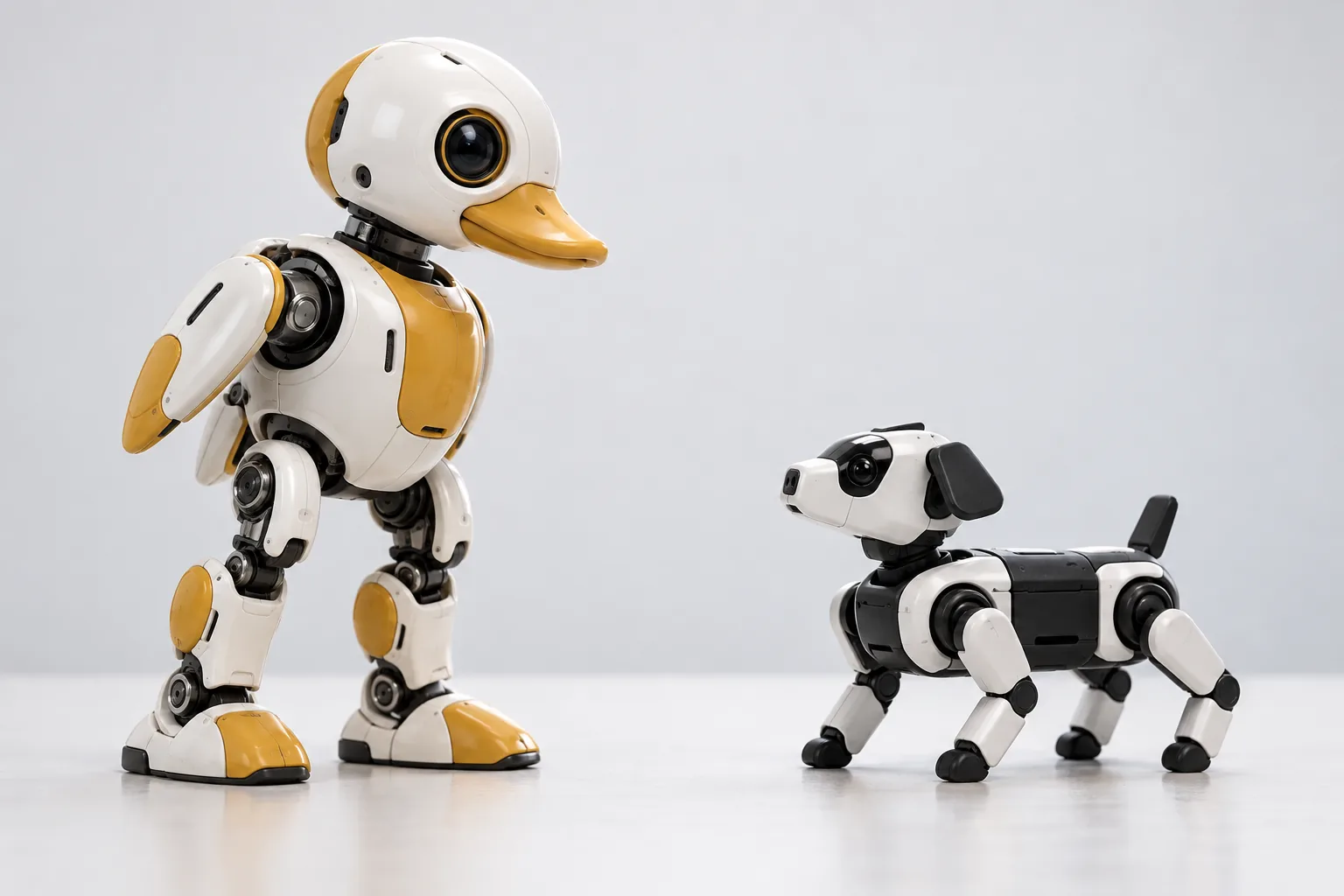
Microduck and Petoi Bittle are the two small robots that come up most often when people ask "what should I actually buy to learn robotics?" They are both small, both walk, and there the resemblance mostly ends - one balances on two legs and learns its gait with reinforcement learning, the other trots on four legs and is programmed like an Arduino project.
The short answer
- You want to learn modern robot learning - policies, simulation, sim-to-real - that is a Microduck, $399.
- You want a gentle, robust first robot for a kid, a classroom or a weekend project - that is a Petoi Bittle X, kit-dependent pricing around $300.
- Two legs or four? Two legs is the harder, more interesting physics; four legs is the more forgiving one.
What Microduck is
A 25 cm two-legged duck that balances, walks, kicks and gets back up, with seven trained moves installed. The learning path is the product: the Python SDK, the simulator and the reinforcement-learning stack are all open, so you move from driving it, to programming it, to training your own gaits.
What Petoi Bittle X is
A palm-sized four-legged robot dog built by Petoi. It is Arduino-based, controlled from an app or from code, and its OpenCat framework is open source. The design philosophy is STEM first: quick wins, friendly hardware, and a robot that survives the classroom. Its cat-shaped sibling is called Nybble.
Side by side
| Microduck | Petoi Bittle X | |
|---|---|---|
| Price | $399 before taxes and shipping | Around $300, kit-dependent |
| Legs | Two - it balances on every step | Four - statically stable by design |
| Size | 25 cm, about 800 g | Palm-sized |
| Sensing | Camera, LiDAR and two IMUs | Camera add-on options; core kit is motion-focused |
| Programming | Python SDK, simulator, RL stack - open source | Arduino-style coding with the open OpenCat framework |
| The learning arc | Drive it, script it, retrain its moves | Build it, code it, teach it tricks |
| How it moves | Learned policies, sim-to-real transfer | Scripted gaits and behaviours |
| Best for | Learning reinforcement learning on real hardware | First robots, kids, classrooms, STEM courses |
Two legs vs four legs, plainly
A quadruped is statically stable: stand a Bittle still and it stays up even switched off. A biped is a controlled fall on every step - which is exactly why it is the interesting one. Balancing, catching a stumble and getting back up after a push are the moves that teach you what reinforcement learning is for, and they are the moves Microduck ships trained and open for retraining.
Bittle teaches you the other half of robotics: hardware assembly, embedded coding, sensors, and the patience of debugging real motors - with a body plan that forgives mistakes.
Which should you buy?
Pick Microduck if: you are comfortable with Python, curious about sim-to-real and reinforcement learning, and want a robot that makes that frontier tangible this year.
Pick Bittle if: the robot is for a child, a classroom or a first build, or you want a robot that is hard to break and easy to explain.
A fair tie-breaker: think about what you want to be true in three months. If it is "I trained a robot", the duck. If it is "I built a robot", the dog - and then, honestly, the duck anyway, because that is how this hobby works.
Microduck vs Petoi Bittle: FAQ
Can Bittle be retrained with reinforcement learning? It is programmed rather than policy-trained in the RL sense; OpenCat is a scripted framework. If RL is the goal, choose a platform that publishes its training stack - Microduck or Open Duck Mini.
Is Bittle cheaper? Usually, yes, depending on the kit - around $300 against $399. Neither price includes taxes and shipping.
Which is easier for a beginner? Bittle, by a comfortable margin: four legs are stable, the kit is designed for learning, and the first win comes fast. Microduck rewards a little more patience with a much deeper learning curve.
Which is better for a classroom? Bittle X, on price per desk and on robustness. Microduck suits advanced students ready for Python and RL.
Can I own both? Yes, and they teach genuinely different things: quadruped stability and embedded coding versus biped balance and learned policies.
Where to go next
- Microduck alternatives - the full field, honestly compared
- Microduck vs Open Duck Mini - the other biped question
- Pre-order Microduck - if the duck wins
- Best open-source robots in 2026 - the shopping-list version