
Microduck alternatives: the small robots worth comparing in 2026
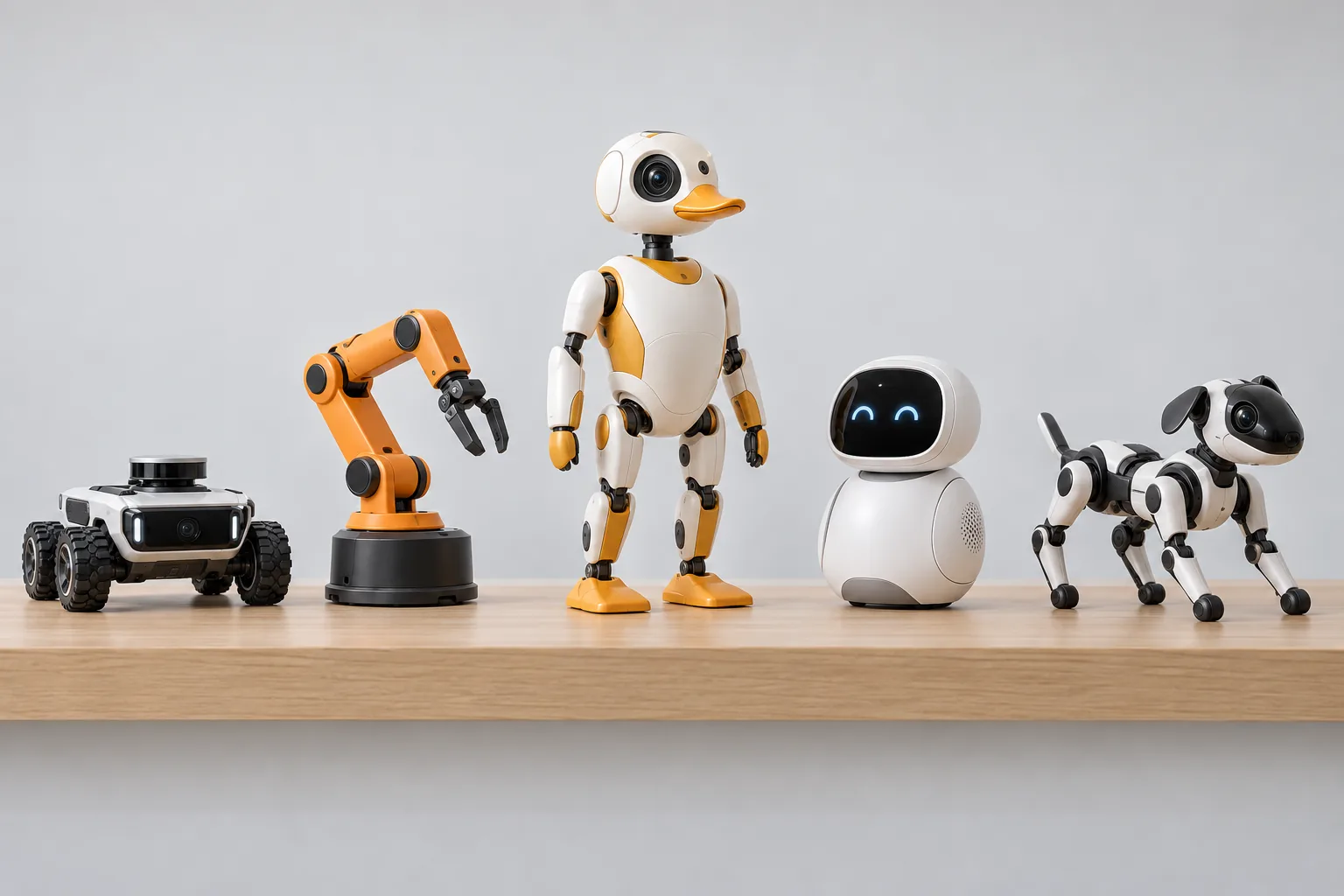
"Microduck alternative" is a search with many right answers, because Microduck is not one thing - it is a walking robot, a reinforcement-learning platform and a desk companion at the same time, and most alternatives do one of those jobs better. This page is the honest tour. We make Microduck, so read it knowing that; the goal here is that you end up with the right robot, ours or not.
The short answer
- You want to build the whole robot yourself - Open Duck Mini v2, the fully open project.
- You want interaction and apps, not walking - Reachy Mini, the desk companion.
- You want a quadruped robot dog for learning and STEM - Petoi Bittle.
- You want an arm that learns manipulation - LeRobot SO-101.
- You want a walking humanoid that works out of the box - Hiwonder TonyPi.
- You want a desk companion pet - Eilik or Loona.
- You want a serious mobile robot platform - the Unitree step-up.
- You want a walking robot you can retrain, shipped assembled and supported - that is a Microduck.
The landscape at a glance
| Robot | Rough price | What it is | Open in what way | Best for |
|---|---|---|---|---|
| Microduck | $399 | 25 cm biped duck, walks and kicks, RL-retrainable | Software, SDK, simulator and RL stack (Apache-2.0) | Learning sim-to-real locomotion on real hardware |
| Open Duck Mini v2 | Parts in the low hundreds to around $500 | DIY biped you print, source and assemble | Everything - CAD, BOM, printed parts, runtime, training | Makers who want the whole project |
| Reachy Mini | $399 Lite / $499 Wireless | Expressive desktop companion robot | Design files and SDK; a big library of apps | Interaction, creative coding, AI experiments |
| Petoi Bittle X | Around $300, kit-dependent | Palm-sized quadruped robot dog | OpenCat software framework is open; the kit is a product | STEM learning, classrooms, first robots |
| LeRobot SO-101 | Around $250 in parts | Small robot arm for manipulation | Fully open design; assembled kits exist | Learning imitation learning and grasping |
| Hiwonder TonyPi | Around $480 | Ready-made walking humanoid | Closed platform with app and Python programming | A humanoid that walks without assembly |
| Eilik | Around $140 | Small emotive desk companion | Closed; fixed behaviours | A desk pet for fun |
| Loona | Around $440 | Wheeled pet robot with personality | Closed; app and games | Personality-driven companionship |
| Unitree Go2 | Around $1,600 | Full-size quadruped mobile robot | Commercial platform with an SDK | Serious robotics projects and research |
Prices move constantly and shipping differs by country - treat these as signals, not quotes, and check each maker for the current number.
Open Duck Mini v2 - if you want to build
Open Duck Mini v2 is the closest thing to a sibling project: a miniature biped with the same spirit, but distributed as a project instead of a product. You print the parts, source the motors, flash the runtime, and train policies with the community. If the build is the point - printing, wiring, debugging, learning every subsystem - there is no better alternative, and the project is genuinely friendly, with build guides and a long-running community.
The honest caveat: you are the support, the spares department and the quality control. Expect weeks, not evenings, and expect the first walk to be a milestone you earn. If that sounds like the fun part, go build one. If you want the learning without the assembly, the buy-or-build comparison goes deeper.
Reachy Mini - if you want interaction
Reachy Mini is the other Pollen Robotics robot, and the choice between it and Microduck is the easiest to reason about: Microduck walks, Reachy Mini interacts. It listens through a four-microphone array, speaks through a speaker, runs ready-made apps, and is programmed in JavaScript - the friendlier path if your background is web development. It stays on the desk by design; a desk-bound robot will never fall off it.
The honest caveat: you will not learn legged locomotion with it. Microduck vs Reachy Mini covers the two side by side in detail.
Petoi Bittle X - if four legs fit the project
Bittle X is the small quadruped robot dog that shows up in every robotics classroom discussion - palm-sized, kit-based, and programmed through the open OpenCat framework with a friendly app. Quadrupeds are more forgiving than bipeds, which makes Bittle a softer first robot for students.
The honest caveat: you program it, you do not retrain its gait with your own reinforcement learning; a quadruped also teaches different physics than a balancing biped. The head-to-head is here.
LeRobot SO-101 - if you want manipulation
SO-101 is the low-cost arm from the LeRobot ecosystem, buildable for around $250 in parts with assembled kits widely available. If the skill you want is grasping, imitation learning and manipulation, an arm beats any walker - that is simply the right tool for the job.
The honest caveat: it does not walk, it does not balance, and locomotion research stays out of reach.
Hiwonder TonyPi - if you want a ready-made humanoid
TonyPi walks and gestures straight out of the box and is programmed through an app and Python. If the goal is "a humanoid walking robot on my desk with zero assembly", it delivers exactly that.
The honest caveat: the platform is closed, and you do not train its gait - you use the one it ships with. For the sim-to-real learning experience, a retrainable duck is the different animal.
Eilik and Loona - if you want a companion
Eilik is the $140 desk pet with big eyes and moods; Loona is the $440 wheeled pet with personality, games and tricks. Both are fun, neither is a platform: behaviours are fixed, and there is no SDK path to teach them new gaits.
The honest caveat: these are companionship, not robotics education. If your goal is learning, you will outgrow them in a weekend.
Unitree Go2 - the step up
At around $1,600, the Go2 is a different league - a full-size quadruped platform with an SDK, used for research and serious demos. If your budget and ambition are at that level, compare it against the whole field, not against desk robots.
How to choose in 60 seconds
Answer two questions honestly:
- Do you want to build or to use? Build: Open Duck Mini v2 (biped) or SO-101 (arm). Use: everything else.
- What is the skill you want? Walking on hardware: Microduck. Interaction: Reachy Mini. Classroom STEM: Bittle. Manipulation: SO-101. Companionship: Eilik or Loona.
When Microduck is the wrong choice
- You want a pet that reacts to affection - buy Eilik or Loona.
- You want a robot that walks perfectly with zero learning curve - TonyPi or Reachy Mini.
- You want the full engineering project, not the product - build an Open Duck Mini v2.
- You need a robot today with no pre-order wait - everything on this page that is in stock beats a pre-order, ours included.
Microduck alternatives: FAQ
Which alternative is closest to Microduck? Open Duck Mini v2 - both are small walking bipeds trained with reinforcement learning. One is a finished product, the other is a build-it-yourself project.
What is the cheapest walking robot here? The SO-101 arm kits are the cheapest hardware but do not walk; among walkers, Open Duck Mini v2 built by you and Microduck bought finished land in the same price neighbourhood.
Can any of these be retrained with my own policies? Microduck and Open Duck Mini v2 both publish full RL stacks. Bittle and TonyPi are programmed, not retrained, in the RL sense.
Are they all open source? Varying degrees - the table above is honest about which are open projects and which are products with open parts.
Which is best for a kid or a classroom? Petoi Bittle X, comfortably - smaller, softer, and built around group learning.
Where to go next
- Microduck vs Open Duck Mini - the buy-or-build decision in detail
- Microduck vs Petoi Bittle - biped or quadruped
- Microduck vs Reachy Mini - the two Pollen robots
- Best open-source robots in 2026 - the shopping-list version of this page
- Where to buy Microduck - if the duck wins