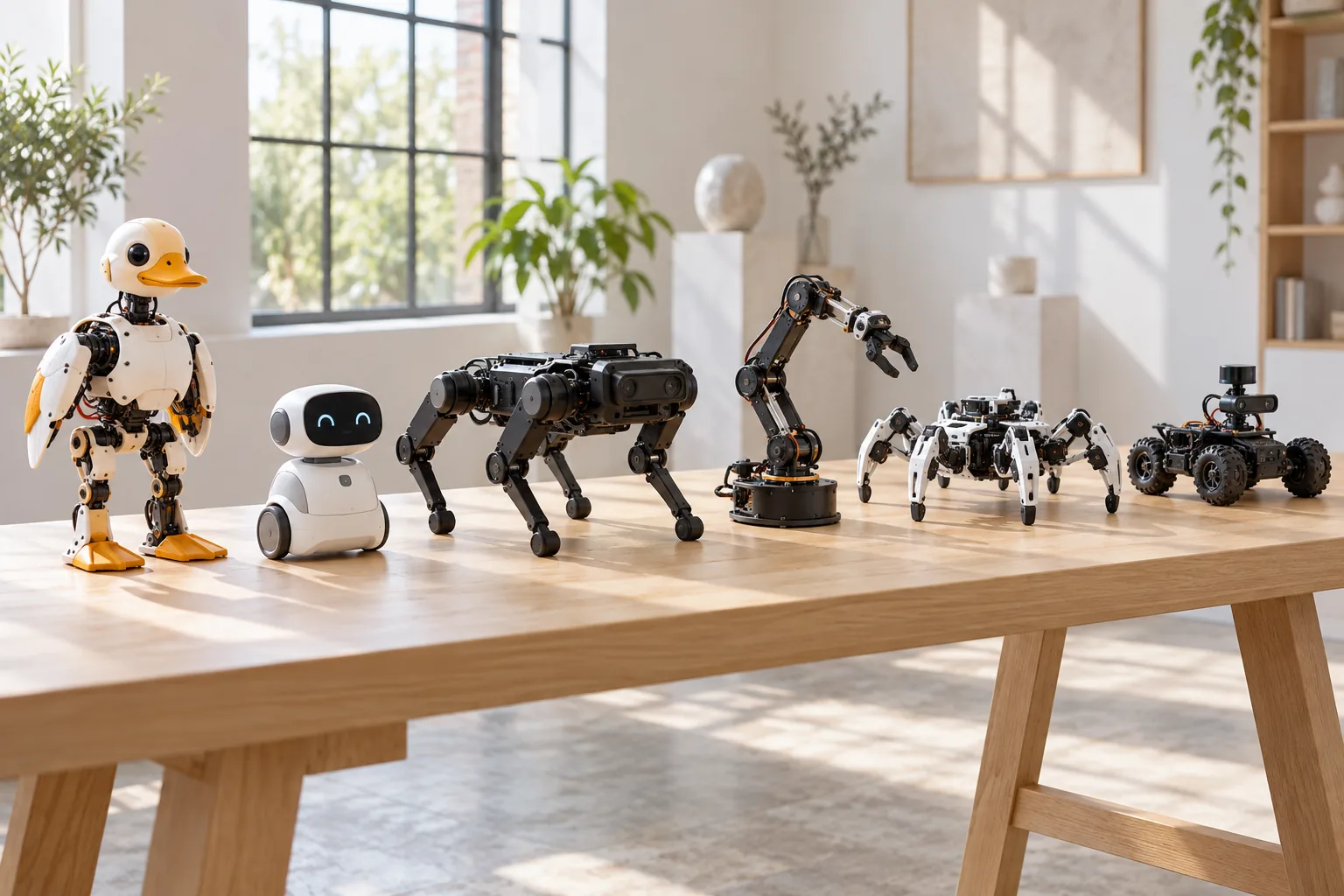
"Open source robot" is one of those phrases that means five different things. Sometimes it means the code is public but the hardware is a black box. Sometimes it means the whole design is yours to rebuild. Sometimes it means a project you assemble yourself; sometimes it means a product with an SDK. And "best" depends entirely on the job you have in mind.
So here is the honest version: the open-source robots that actually exist in 2026, what "open" means for each one, and who each is for. Full disclosure - we make Microduck, the first entry; the other eight earn their places on merit, and half of them beat the duck at their own job.
How to read this list
Two axes matter more than any spec table:
- How open? Code open, design open, or both. A build-it-yourself project is maximally open and maximally demanding. A product with a public SDK is less open and far more usable.
- What job? Walking, interacting, manipulating, teaching, or just sitting on your desk being charming.
Prices move constantly and shipping depends on your country - check each maker for the current number before you budget.
1. Microduck - the walking duck, $399
A 25 cm biped that stands, walks, kicks, grabs and gets back up, with seven trained moves installed and a Python SDK, simulator and reinforcement-learning stack published under Apache-2.0. You drive it out of the box and retrain it when you are ready - the shortest path we know from "unboxed" to "I trained a policy that walks". The specs page has every number; the buy-or-build comparison covers the main alternative.
Openness: software, SDK, simulator and RL environments, Apache-2.0.
2. Reachy Mini - the interaction robot, $399 Lite / $499 Wireless
The other Pollen Robotics robot. It listens through a microphone array, speaks, makes eye contact and runs a library of ready-made apps - built for human interaction and creative coding rather than locomotion. Programmed in JavaScript, which makes it the gentler on-ramp for web developers.
Openness: open design files and SDK, with a large app ecosystem.
3. Open Duck Mini v2 - the build-it-yourself biped
The fully open miniature biped project: CAD, bill of materials, printed parts, runtime and training approach all published, with build guides written by the community and a little sponsorship from Hugging Face. If "open source robot" to you means you own every part of the machine, this is the one - budget weeks, tools and patience rather than a checkout.
Openness: everything - design, electronics, runtime and training.
4. Petoi Bittle X - the classroom quadruped, around $300
The palm-sized robot dog that shows up in every STEM classroom conversation. Arduino-based, app-friendly, and programmed through the open OpenCat framework. Four legs are stable, the kit survives students, and the first win comes fast.
Openness: the OpenCat software framework is open; the kit itself is a polished product.
5. LeRobot SO-101 - the learning arm, around $250 in parts
The low-cost arm from Hugging Face's LeRobot ecosystem. Buy a kit or print and assemble, then learn imitation learning and grasping - the other half of embodied AI, where the robot affects the world with hands instead of feet.
Openness: fully open design, with a fast-growing tutorial ecosystem.
6. Hiwonder TonyPi - the ready-made humanoid, around $480
A small humanoid that walks and gestures out of the box, programmed through an app and Python. If you want humanoid walking without any assembly or training arc, it is the shortcut.
Openness: a closed platform with programming access - open in input, not in rebuild.
7. Eilik - the desk pet, around $140
A tiny emotive companion with big eyes and a personality. Fixed behaviours, no SDK, and honestly delightful. The right pick when the goal is a desk friend rather than a robotics education.
Openness: closed - but that was never the point.
8. Loona - the wheeled pet, around $440
A rolling pet robot with personality, games and tricks, built to be lived with rather than programmed. Charming, and a different category from everything above.
Openness: closed platform, app-based play.
9. Unitree Go2 - the step up, around $1,600
The full-size quadruped that turns up in every robotics research showcase, with an SDK and serious mobility. If your projects have outgrown desk robots, this is the class above - at the price to match.
Openness: a commercial platform with developer access, not open hardware.
How to choose in three questions
- Do you want to build, or to use? Build: Open Duck Mini v2 or SO-101. Use: everything else.
- Which skill do you want? Walking and balance: Microduck. Interaction: Reachy Mini. Manipulation: SO-101. Classroom STEM: Bittle. Companionship: Eilik or Loona.
- What is your budget shape? A few hundred dollars covers every serious option on this list; a companion is cheapest; the Unitree tier is a different conversation.
And one rule from experience: buy the robot whose community matches your patience. An open project with a lively community will take you further than a better spec sheet with a quiet forum.
Best open-source robots: FAQ
Which of these is the most open? Open Duck Mini v2 and SO-101 - the full design is yours. Among finished products, Microduck and Reachy Mini open their software stacks.
Which one can I retrain with my own policies? Microduck and Open Duck Mini v2 publish complete reinforcement-learning stacks; the rest are programmed rather than policy-trained.
Which is best for kids? Petoi Bittle X, by a wide margin - and Eilik if the kid in question is small and the goal is fun.
Which of these actually walks? Microduck, Open Duck Mini v2, TonyPi and the Unitree Go2 - two legs, two legs, two legs, four wheels of the quadruped kind.
Where do I compare them properly? The alternatives tour goes deeper pair by pair, including vs Reachy Mini, vs Open Duck Mini and vs Petoi Bittle.
Where to go next
- Microduck alternatives - the comparison tour
- Microduck specs - the duck in numbers
- How to train Microduck - what the RL path looks like
- Where to buy Microduck - price, packs and countries