
Microduck vs Open Duck Mini: buy a finished duck or build one?
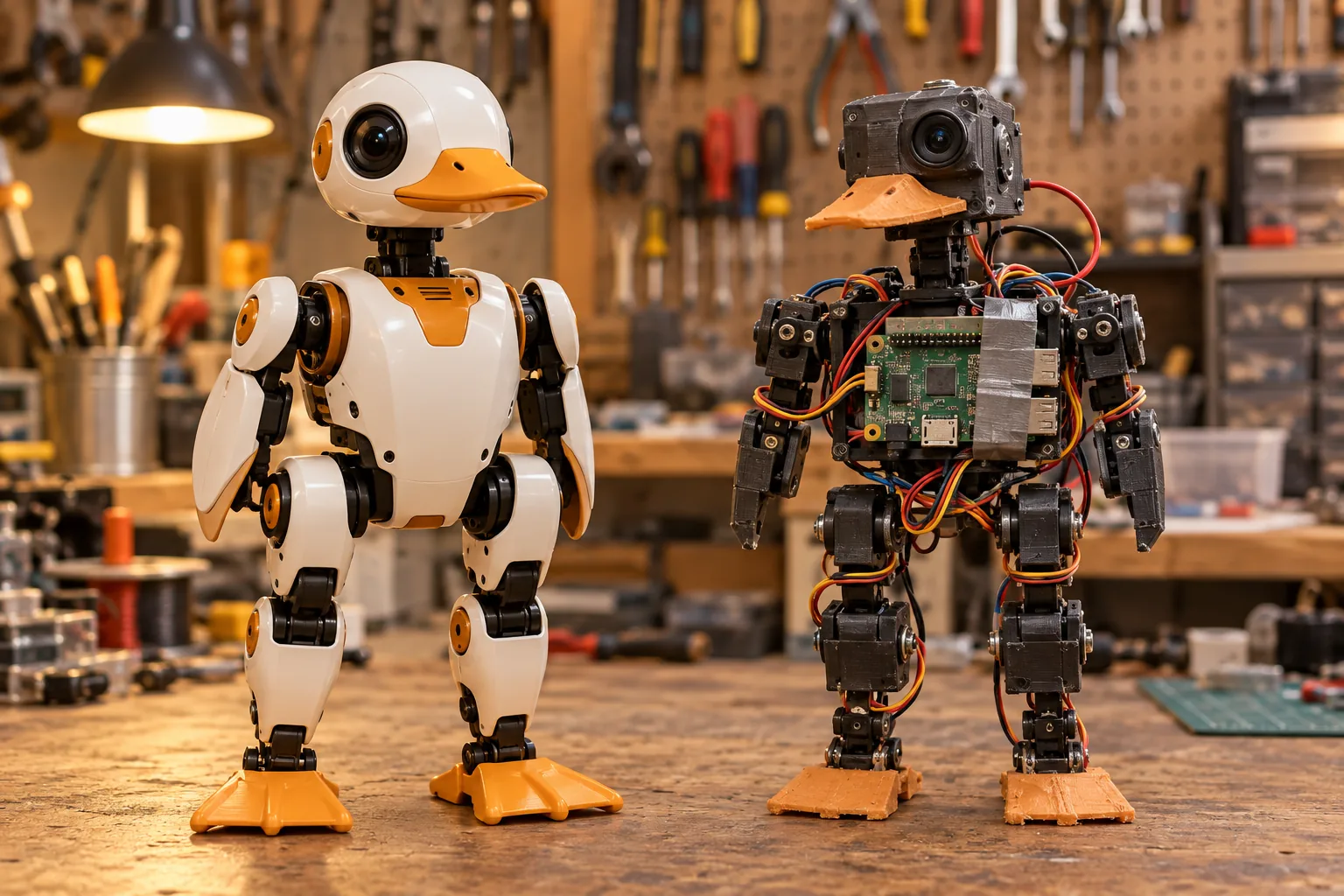
"Microduck vs Open Duck Mini" is really one question wearing a comparison costume: do you want to buy a robot or build one? Both are small walking bipeds, both are trained with reinforcement learning, and both believe the code should be public. The difference is who assembles the machine.
The short answer
- You want to walk a robot this month, with support and spares - buy the Microduck, $399, assembled and calibrated.
- You want the whole build as the hobby - printing, wiring, flashing, debugging - build an Open Duck Mini v2. There is no better project of its kind.
- You want both, eventually - and most makers end up there: buy the duck, then build the next thing with what you learn.
What Open Duck Mini v2 is
Open Duck Mini is an open-source project, not a product. It started as a miniature take on the Disney BDX-style droid and grew into a community: the CAD, the bill of materials, the printed parts, the onboard runtime and the training approach are all published, and the build guides are written by the people who built it - a project sponsored in part by Hugging Face. The hardware is yours to claim: print the shell, order the motors, assemble, flash, and train your first walking policy.
What you are buying into is a project with all the texture that word implies - forums, remixes, broken parts, breakthroughs.
What Microduck is
Microduck is the finished version of the same idea. A 25 cm biped duck ships assembled and calibrated with seven trained moves installed, a controller in the box and support behind the order. Under the shell, the software side is public: the Apache-2.0 repositories publish the robot software, the Python SDK, the simulator and the reinforcement-learning stack, so you can inspect the brain, retrain it and mod the machine - you just do not have to build the body first.
Side by side
| Microduck | Open Duck Mini v2 | |
|---|---|---|
| What arrives | A finished, calibrated robot in one box | Files, parts lists and guides - the robot arrives as a project |
| Time to first walk | Minutes out of the box | Weeks of evenings, by most builders accounts |
| Cost shape | $399, once, taxes and shipping at checkout | Parts in the low hundreds to around $500, plus printer time, tools and spares |
| Openness | Software, SDK, simulator and RL stack (Apache-2.0) | The full stack: mechanical design, electronics, runtime and training |
| Training stack | Published - train with the same workflow | Published - trained with the community approach |
| Support | Maker support, spares packs, community Discord | Community support - you are your own spares department |
| Best for | Learning sim-to-real on hardware with a net under you | Makers who want the deepest possible build |
The real cost of building
Count what an Open Duck Mini v2 build involves before the parts list: the printer or a print service, the motors at the right spec, the electronics, the fasteners, the cables, the spare parts you will inevitably re-order, the tools, and the weeks of assembly, calibration and policy work. The parts bill can undercut a finished Microduck on a good day; the whole project rarely does, and it was never supposed to. You do not build an Open Duck Mini to save $399 - you build it because building it is the point.
Where Open Duck Mini wins
- Everything is buildable. You own the design, down to the geometry. No part is off-limits.
- The build teaches everything. By the first walk you will have touched the mechanics, the electronics and the training loop in one project.
- The community is the product. Remixes, mods and build logs are the texture of the project - and it is genuinely fun.
Where Microduck wins
- It walks the day it arrives. Seven trained moves, calibrated joints, a controller in the box.
- You practice the modern part first. The interesting frontier is the policy, not the soldering - train in simulation, deploy to the robot, tune for reality.
- Support exists. Spares, the Dev pack, and a support address that answers.
Can you do both?
Yes, and it is the natural path. Buy the duck to learn the software loop end to end - the SDK, the simulator, training, deployment - with a robot that always works. Then take on the Open Duck Mini build with trained intuition for what the hardware has to survive. The two communities overlap more than the two projects compete.
Microduck vs Open Duck Mini: FAQ
Is Open Duck Mini v2 a product I can order? It is a project: you get designed files and a community, not a shipping box. Assembled builds sometimes circulate inside the community.
Can I build an Open Duck Mini for less than $399? Sometimes, on parts alone. Rarely once tools, spares and your evenings are counted honestly.
Which one can I retrain? Both publish reinforcement-learning stacks. Microduck adds a shipped product, support and its own training environments; Open Duck Mini adds the full mechanical design.
Which is better for a beginner? Microduck - turn it on, drive it, break policies instead of parts. Build the Open Duck Mini second.
Do the projects share code? They share an ecosystem of ideas, and both stand on the same open reinforcement-learning traditions - not a common codebase.
Where do I start if I am still deciding? Read the Microduck DIY guide for the honest build-vs-buy math, and the alternatives tour for the wider field.
Where to go next
- Pre-order Microduck - the buy path
- Open Duck Mini v2 on GitHub - the build path
- How to train Microduck - the RL workflow you would learn on either
- Microduck alternatives - the wider field, compared