
Microduck vs Beni: two open-source robot projects compared
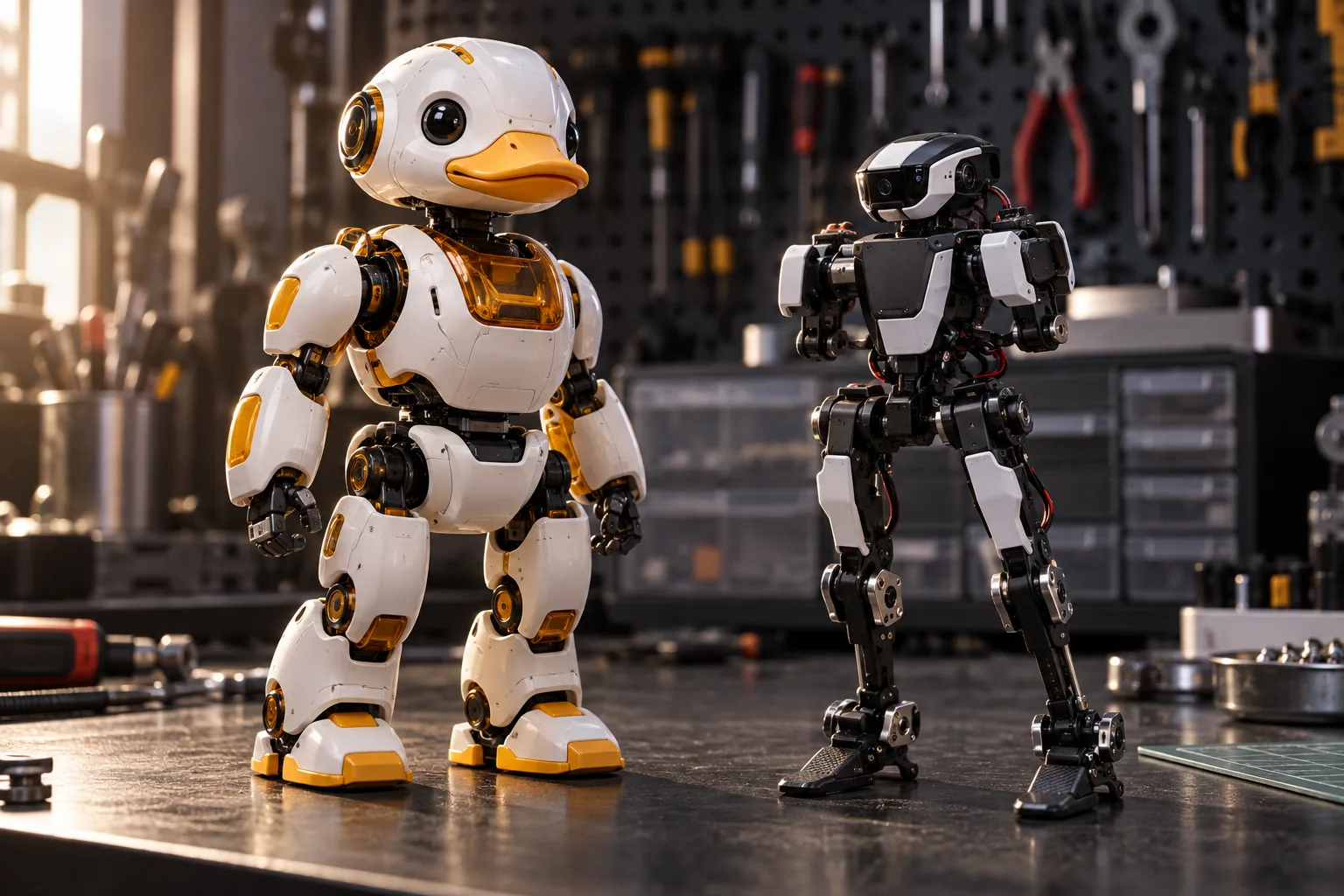
"Microduck vs Beni" is one of the more interesting comparison searches because the two projects look like competitors from a distance and are almost nothing alike up close. Beni is an open-source browser game where a simulated robot races, built with MuJoCo WebAssembly and ONNX policies. Microduck is a physical 25 cm biped duck you can pre-order for $399 and train with reinforcement learning. Different mediums, shared roots: both live in the mjlab training ecosystem.
The short answer
-
Beni: race a robot in your browser for free. MIT-licensed, MuJoCo WebAssembly, training source included.
-
Microduck: a real robot on your desk. Apache-2.0, $399, trained with the same class of reinforcement-learning tooling.
-
They are not competitors. Beni is a game; Microduck is hardware. If you like one, you will probably like the other.
What Beni (OpenBeni) is
OpenBeni is published by Mondo Robotics and carries the complete browser game, server, training source, robot assets and policies under the MIT license. You play it as a Hugging Face Space, racing in the browser - no install, no hardware.
Under the hood:
-
MuJoCo WebAssembly runs the physics in the browser.
-
ONNX policies drive the simulated robot.
-
The training source is public, including flat-terrain velocity tracking, recovery and jumping built on mjlab and MuJoCo Warp.
-
You can also build and run it from source with Docker if you want the local version.
What Microduck is
Microduck is a physical robot: 25 cm tall, about 800 g, 15 motors, with a camera, LiDAR and two IMUs, and a 50 Hz onboard policy loop. Seven moves ship trained - standing up, sitting and standing, walking, turning, kicking, driving and grabbing - and every one of them is a policy you can retrain, because the reinforcement-learning environments are public in the microduck_rl repository.
The honest appeal: it is a walking robot you can hold in one hand, and the entire sim-to-real loop is open.
Side by side
| Microduck | Beni (OpenBeni) | |
|---|---|---|
| What it is | Physical 25 cm biped duck robot | Browser robot racing game |
| Cost | $399 before taxes and shipping | Free to play; source is public |
| Where it runs | On your desk | In your browser (MuJoCo WebAssembly) |
| License | Apache-2.0 | MIT |
| Training stack | mjlab-based RL environments, public | mjlab and MuJoCo Warp, public |
| Policies | Seven trained moves, retrainable | ONNX policies, with training source |
| Hardware needed | The robot for hardware work; none for simulation | None |
| Best for | Owning and training a real walking robot | Trying robot control instantly, racing, teaching |
Why you might run both
-
Learn cheap, apply expensive. Race and experiment in Beni for free; carry the same mental model - policies, rewards, sim-to-real - onto Microduck hardware.
-
Both are mjlab projects. Both train in the mjlab ecosystem (Microduck through microduck_rl, Beni through its mjlab-based training source), so time spent in one is not wasted in the other.
-
Teaching. A browser race is the fastest possible "here is what RL looks like" demo for a class; a Microduck on the desk is the payoff.
Which one is right for you
Beni if you want to try robot racing right now, for free, with zero hardware and zero setup.
Microduck if you want the physical robot: the thing that walks, kicks and gets back up on your desk, with an open SDK and an open training stack behind it.
Both if you are serious about learning robotics - the browser game teaches the loop, the duck makes it real.
Where to start
-
Microduck simulator - run the duck robot in your browser or locally
-
How to train Microduck - the reinforcement-learning workflow, step by step
-
Where to buy Microduck - $399, packs, and how ordering works
-
Play OpenBeni - the browser race
Microduck vs Beni: FAQ
Is Beni a competitor to Microduck? No. Beni is a browser game; Microduck is a physical robot. They share tooling and a spirit more than a market.
Do both use reinforcement learning? Yes. Beni's policies are trained with mjlab-based tooling and published as ONNX; Microduck's seven moves are RL policies with public training environments.
Which is free? Beni is free to play and MIT-licensed. Microduck is a $399 pre-order - the software around it is open source, the hardware is not free.
Can I train a policy in one and use it in the other? Not directly - they are different robots in different engines. But the workflow transfers: reward shaping, domain randomisation and sim-to-real habits are the same skills.
Which should a beginner start with? Beni, for the zero-setup taste of robot control. Then Microduck when you want hardware.